Why mitochondrial peptides are the missing link in insulin sensitivity
Mitochondrial peptides like MOTS-c are studied for links between cell energy and insulin sensitivity, and how to check purity on a certificate.
ReadyPep Research Desk12 min read

Insulin resistance is widespread, and researchers link it to what cells are doing inside their energy factories. In widely cited analyses of mitochondrial biology in diabetes, researchers highlighted that diabetes prevalence is high enough to shape global health planning, and that the populations they study carry a substantial burden of the condition.
Key takeaways
| Research area | What mitochondrial peptides target in the research |
|---|---|
| Mitochondrial signaling | Mitochondrial signaling that connects energy production to glucose handling, including pathways involving AMPK and stress-responsive peptide signals. |
| Cell energy and NAD+ | Mitochondrial derived peptides and NAD+ are researched for how cells make energy, because both sit in cell energy circuits. |
| Tissue repair and post-training recovery | Research use compounds in this category are also positioned for recovery and repair endpoints, including inflammation control and connective tissue support. |
| Growth hormone axis | Some buyers combine mitochondrial derived peptides with growth hormone secretagogues and GHRH analog style approaches in peptide stacks and protocols to cover cell energy, tissue repair, and recovery endpoints. |
| Joint, gut, and immune modulation | Peptides used in repair stacks are researched for tissue-level signaling that can intersect immune tone and gut barrier or inflammation pathways. |
| Skin | Some peptide research products in recovery-focused stacks are aimed at connective tissue and inflammation pathways relevant to skin appearance and healing signals. |

- When buyers say "missing link," they usually mean a signaling pathway that ties mitochondrial function to how cells handle glucose, not only a single hormone.
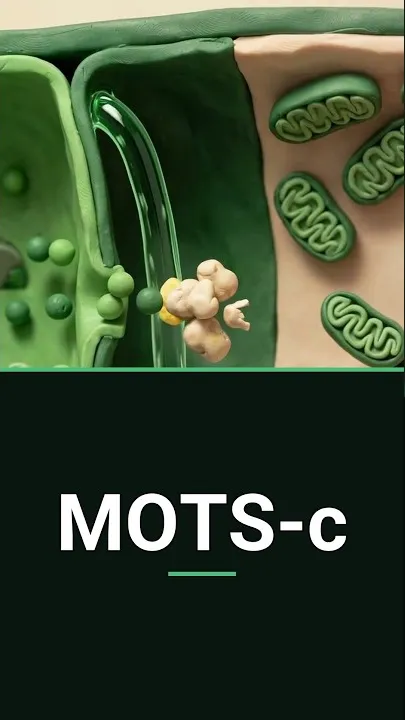
- MOTS-c is a mitochondrial derived peptide studied in diabetes research, with reported statistical differences between people with type 2 diabetes and controls.
- In 2026, people want proof. You can see our lab testing overview and certifications page to learn how we verify our products.
- To compare products, you should understand how to read a certificate of analysis, including purity versus content.
- For storage and handling, start with our shipping guidance, because cold-chain matters for sensitive peptides.
This article summarizes published research on mitochondrial peptides (small proteins that help cell energy) and insulin sensitivity. It does not give instructions on how to use them.
Mitochondrial peptides and cell energy endpoints
Buyers often ask what published studies actually measured in people. They want to see results that match how the body handles insulin, not just theories. Published research reports a link between these peptides and markers such as HbA1c and glucose.
Even if a product description focuses on one step, the final result is what matters. In that same body of research, the link between MOTS-c and HbA1c (a long-term blood sugar marker) had strong support, with higher MOTS-c levels tracking with lower HbA1c. This is important because HbA1c tracks long-term sugar levels rather than short-term changes.
About cell energy, the logic is simple. Activating AMPK (a protein that regulates energy) changes how cells use energy. Studies look at whether this pathway changes insulin sensitivity markers and tissue stress. For research, this is why MOTS-c is studied as a cell energy signal instead of a general wellness topic.
By 2026, buyers will want a practical package. They do not just ask what a compound is for. They also ask how it is sent and verified. This is because purity, content, and identity confirmation change research results. We meet these needs through our lab testing and documentation, starting with how ReadyPep works.
Tesamorelin, GHRH analogue logic and the growth hormone axis
Growth hormone acts on many tissues, and studies measure tissue repair and recovery endpoints. Certain compounds that trigger growth hormone (growth hormone secretagogues) or mimic its signals are studied for how they change growth hormone release. In research, these signals are tracked with markers measured over time.

Tesamorelin is used to change how the body handles growth hormone. It tells the pituitary (a small gland at the base of the brain) to release more growth hormone. Studies of tesamorelin measured visceral fat (fat stored around the organs) and waist size. Visceral fat is measured because it is closely linked to insulin resistance.
In 2026, more buyers ask if mitochondrial peptides can be used with growth hormone axis modulators. This is because mitochondrial signaling manages energy inside cells. Growth hormone axis modulators are studied for recovery and tissue endpoints.
When people combine peptides, they often want to cover cell energy, tissue repair, and recovery. This mix is why the research goals listed in the key takeaways table above appear as a group instead of one single factor.
Tissue repair, recovery, and BPC-157, TB-500, and GHK-Cu
Insulin sensitivity is not just about blood sugar levels. It also involves inflammation and how well the body repairs tissue, since long-term inflammation can cause insulin resistance (when the body does not respond well to insulin). This is why people often ask about tissue repair and recovery tools at the same time.
Researchers often study BPC-157 and TB-500 together for tissue repair. Our catalog lists this pair as a way to support healing. Repair signals and inflammation are studied alongside tissue stress.
Researchers often study GHK-Cu for tissue repair and recovery endpoints. GHK-Cu is a copper-bound tripeptide (a small protein) used to study tissue regrowth and copper balance. It may change how genes handle repair and inflammation. Studies also measure inflammation markers alongside markers of insulin response.
This pattern also appears in how people use these products for research. Buyers want to cover many goals, such as fixing the gut and joints or managing the immune system. This is why BPC-157 and TB-500 are sold with copper-related repair peptides in recovery plans.
Mitochondrial peptides for neural energy and stress
Research on memory, mood, and thinking often looks at how mitochondria (the cell's power plants) handle energy and stress. Mitochondrial derived peptides are studied because they change how cells use energy and signal stress. These biological changes can affect brain function in research studies.

Buyers care about more than just how a product works. They also want to know how it is supplied and verified. If you use products for research on tissue-specific signaling (how cells send messages), you need reliable test results.
We focus on testing and documentation. You can see our lab tests and use our guide to read a certificate of analysis. This helps you check purity and content. It also confirms the identity of the product using mass spectrometry (a way to identify chemicals).
Some buyers look at CJC-1295, ipamorelin, and thymosin alpha-1 for mood and brain health. These are often grouped with growth and immune support. They are not mitochondrial derived peptides, but people use them for overall energy and body regulation.
Mitochondria-based logic for repair stacks and protocols
Buyers use research on inflammation and tissue repair to help the gut, skin, and joints. Mitochondrial peptides are studied for cell stress signaling. Repair peptides are used to rebuild tissue.
This is why buyers use terms like repair stacks and protocols. When people mention a glow stack, they want to fix skin and connective tissue. They use compounds researched for regeneration and controlling inflammation.
Glow Stack 70mg combines three repair peptides studied for tissue recovery and inflammation control. It targets the skin, connective tissue, and cell regrowth. That is what makes it relevant to skin endpoints, even though its core is a copper peptide rather than a mitochondrial one.
Some buyers use thymosin alpha-1 to help repair joints and lower inflammation. Others use MOTS-c to support mitochondria. They also use NAD+ and Semax to boost energy.
NAD+, Semax, and Selank expectations for 2026
Buyers in 2026 ask how mitochondrial peptides pair with other energy and nerve signaling products. NAD+ is often used because it is central to how cells create energy. Our catalog lists it as a way to support cellular energy and mitochondrial function.

People often use Semax and selank to support memory and mood. We sell Semax 10mg and selank 10mg. Buyers often pair these with items for cell energy and recovery, including peptides that support mitochondria.
This is important for "Why mitochondrial peptides are the missing link in insulin sensitivity." The "missing link" idea is not just about glucose (blood sugar). It is about how the whole body signals energy. By 2026, buyers will want peptide stacks and plans that cover many areas. These include cell energy, tissue repair, and mood or brain health.
We keep the focus on research use to stay practical. Buyers compare the compounds, the documents, and how the products are supplied.
How to compare peptide pen suppliers
When people ask how to compare peptide suppliers, they are asking three things. Do you verify identity, do you verify purity versus content, and do you deliver under conditions that preserve stability.
We provide peptides in pre-filled pens that hold multiple doses. Many suppliers still use vials, but mixing and measuring those can lead to mistakes. We solve this by using pre-filled pens. Our guide explains the difference between these pens, vials, and bacteriostatic water (water used to keep products sterile).
Check the testing methods and result lines in the documents. A good CoA (certificate of analysis) should show HPLC (a way to separate chemicals) purity results and mass spectrometry results. Look at how they test for sterility and endotoxins (toxins from bacteria). See how they report content versus purity. You want enough detail to prove the shipment is a verified research reagent.
For more details, use our guide on how to read a certificate of analysis (a document showing a product's purity). We also explain our rules for research use only.
We use cold-chain shipping (keeping products cold during transport) and temperature-controlled handling. You can review shipment expectations on our shipping page.
We also check the paperwork that some suppliers ignore. We look for batch records, lot traceability, and regular tests from outside labs (third party lab testing). Our focus on these documents is shown in our lab testing and certifications.
Pen format, handling, stability and shipping
Research methods often differ during the mixing and handling stages. When using vials, you must mix, measure, and move the liquid. Each of these steps can lead to mistakes. A multi-dose research pen simplifies this process. It reduces the need to mix and measure, which keeps your experiments more consistent.
The pen format is more than just convenient. It helps peptides stay stable and last longer. This is because you open the containers less often. It also reduces the time the material spends outside of controlled conditions. For buyers who care about stability, this is why pre-filled peptide pens matter.
We use cold-chain shipping to control our supply. Peptide stability can change if the temperature rises during delivery. You can find our transit policies in cold-chain in transit and the operational details on shipping.
Shipping internationally adds new challenges. Customs and import rules depend on how well the paperwork matches the shipment. We explain these logistics on our shipping and FAQ pages. Start with the FAQ if you want to see how the process works.
The buying process does not end with an order. It also includes expectations for refunds, guarantees, and support timing. You can start at the how ReadyPep works page. Then, use the ReadyPep observatory for guides and documents.
How the stack logic ties to cell energy
We designed this approach to match what buyers want. The cell energy part asks about mitochondrial signaling. The recovery part asks about healing after training, as well as repairing tissues, joints, and the gut. The skin part asks about healing and signals that control inflammation.
These goals may seem different, but they are linked by inflammation, energy, and how tissues heal. Peptides from mitochondria handle energy and stress. Other compounds focus on repairing tissue and managing inflammation. Modulators of the growth hormone axis are studied for recovery signals and tissue endpoints. People create peptide stacks and protocols to address this entire system.
When a buyer asks why mitochondrial peptides appear in diabetes research, the answer is simple. Mitochondrial signaling links to how the body handles glucose and tissue stress. This is why studies of these peptides often measure tissue stress markers as well.
Mitochondrial peptides are researched as a missing link for insulin sensitivity.
Conclusion
Mitochondrial peptides are studied for links to insulin sensitivity markers. Researchers studied peptides like MOTS-c in people with diabetes. They measured these levels against markers like HbA1c and found a statistical link. This suggests that signals from the mitochondria are studied as part of how cells handle glucose, alongside hormones.
In 2026, buyers do not just ask about mechanisms. They ask for supply clarity, including pre-filled peptide pens, chromatography and purity versus content reporting, and mass spectrometry identity confirmation. We built our buyer journey around that practical need, with lab testing, certifications, and documentation you can read, plus cold chain controls explained in cold-chain in transit. The same checks apply to research-use peptide stacks and protocols across cell energy, tissue repair and post-training recovery, the growth hormone axis, cognition and mood-adjacent endpoints, immune modulation, joint and gut repair, and skin.
Related reading
Common questions
- How do mitochondrial peptides relate to human insulin sensitivity?
- Published research on diabetes has found that MOTS-c (a protein from the cell's energy center) differs between people with type 2 diabetes and healthy people. These levels relate to glucose and HbA1c (a long-term blood sugar test). The differences between groups were statistically significant, and higher MOTS-c levels tracked with lower HbA1c.
- Which mitochondrial derived peptide was measured against insulin sensitivity markers?
- MOTS-c is the main peptide from the mitochondria (the powerhouses of cells) in this line of diabetes research. This is because the results show clear differences between groups. They also show links to markers for insulin sensitivity. Other mitochondrial signals exist in research, but MOTS-c is the one tied to these human findings.
- How do you check the purity, content and identity of mitochondrial peptides?
- Look for a certificate of analysis that shows HPLC (a test for purity) and mass spectrometry (a test to confirm identity). We explain how to read these documents. This helps buyers understand the difference between purity and content instead of trusting marketing claims.
- What are the key supply details for research and testing?
- Both are important. Tests like HPLC (a way to check purity), chromatography, and third party labs ensure the product is reliable. Cold shipping and steady temperatures during travel keep the peptides stable and help them last longer.