What elite athletes know about mitochondrial signalling and recovery
One study of elite triathletes and cyclists showed changes in mitochondrial (cell energy center) capacity after 28 days of training.
ReadyPep Research Desk11 min read

One study of elite triathletes and cyclists showed changes in mitochondrial (cell energy center) capacity after 28 days of training. The second occlusion period tau rate improved by 3.4 ± 2.7 seconds. Elite athletes know that training is not just about muscles. It is also about how cells communicate energy and the timing of recovery. In 2026, more peptide research focuses on these ideas. This includes mitochondrial signaling, fuel switching, tissue repair, and the growth hormone axis.
Mitochondrial signaling for athletes and recovery
When elite athletes talk about "recovery," they usually mean more than soreness. They mean the time window where energy regulation, oxidative stress management, and substrate choice reset so the next training bout drives adaptation rather than debt.

Mitochondrial signaling is how cells handle this process. Training changes the environment inside the mitochondria (the cell's power plants). This triggers communication with the rest of the cell. These signals include ATP demand, redox state, and nutrient sensing pathways. One key point in the Sports Science Exchange overview is that the mitochondrial proteome (the set of all proteins) is complex. It has roughly 1,600 proteins, but mitochondrial DNA only encodes 13 of them. This requires constant communication with nuclear signaling.
Fuel and stress also play a role. Hard exercise can raise the energy needs of muscles by about 100-fold over resting levels. This is why training load and recovery depend on the ability to remake ATP (the main energy source for cells). For elite athletes, the advice to just train harder usually fails. They manage their workouts so the cells get the right signals and recovery removes any blocks.
This matters for mitochondrial signaling and recovery because fuel selection shifts cellular signaling, including the balance between glycolysis and fat oxidation and the upstream nutrient sensing that affects gene expression programs tied to mitochondria.
MOTS-c and NAD+ for energy signaling
In mitochondrial derived peptide discussions, two names dominate how buyers connect mitochondrial signaling and recovery with practical outcomes, MOTS-c and NAD+.
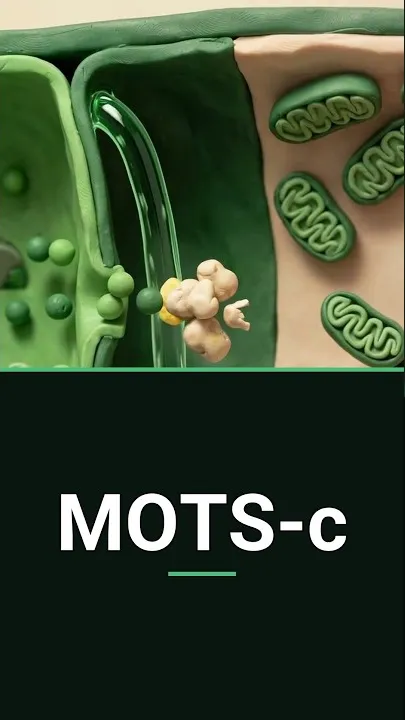
MOTS-c is a peptide (a short chain of amino acids) from mitochondrial DNA. It helps the body manage energy. The product page says it activates AMPK (a protein that acts as the body's master fuel switch). AMPK senses nutrients and energy to help the body adapt. This explains why the catalog discusses energy and fuel handling. This matches how researchers study mitochondria signaling after energy stress.
It helps cells and mitochondria produce energy. Buyers often ask if it improves performance and recovery. Research answers this by measuring metabolic states and how mitochondria work instead of using vague feelings.
For athletes, this is about how much power they can use and how cells handle energy stress. For suppliers, it is about whether a product matches its COA (certificate of analysis) and if the tests prove it.
To compare suppliers, first look at how they test and ship. Only then should you check the product page. This full process is why we show buyers lab testing details and explain how ReadyPep works.
Post-training recovery and tissue, joint, and gut repair
Top athletes focus on recovery in several areas, including muscles, connective tissue, gut health, and inflammation. If any of these are poor, the body cannot return to its normal metabolic state. This can slow down recovery and mitochondrial signaling (how cells create energy).

ReadyPep sells a tissue-repair pairing, BPC-157 with TB-500, aimed at joint and gut research. The page describes the pair as support for gut and joint repair, which matches what these buyers are looking for.
Researchers study these compounds to see how they help heal wounds, reshape tissue, and manage inflammation. Buyers should not assume a label guarantees a result. Instead, they should check that the product passes identity and quality tests. Then, they can compare those results to other suppliers.
Tesamorelin, ipamorelin, and recovery signals
Many athletes think recovery is only about muscles, but it also involves hormones (chemicals that signal the body). Research shows the growth hormone axis is a key way these hormones help repair tissue. This is why buyers ask if stimulating this axis helps with recovery.
Tesamorelin is studied for growth hormone signaling. Its product page refers to recovery. Some buyers ask instead about growth hormone secretagogues (substances that trigger hormone release), and ipamorelin's description links it to growth hormone signaling.
Since the question is about how cells signal for energy and recovery, these parts are linked. Training stress and available fuel change how hormones react. Growth hormone activity is studied for tissue repair. This is why athletes often look for compounds that support both energy and repair.
The catalog also discusses peptides that affect hormones and the brain. It includes images of CJC-1295. This product page meets buyer interest in long acting growth hormone releasing analogs (chemicals that mimic natural hormones). These are framed as signals for the growth hormone axis.
Some people are interested in how thymosin helps the immune system and tissues heal. It is described as supporting and recovering the immune system. This is important if immune stress, not just a lack of energy, slows down recovery.
Immune modulation, mood, memory, and cognitive resilience
Hard training changes how the immune system sends signals. When athletes do not recover well, these signals can shift. This affects training quality and mitochondrial signaling through inflammation and redox stress (chemical imbalance). Immune control is a key part of recovery and mitochondrial signaling, not a side topic.

The catalog lists thymosin alpha-1 for immune recovery. Other options for mood and behavior include selank.
Many buyers want to improve their mood, memory, and thinking. The catalog offers items like kisspeptin, which relates to signals in the hypothalamus (a part of the brain). It also lists MOTS-c, NAD+, and other compounds that signal energy. These help the brain by providing energy and managing cellular stress.
Research on mood and thinking usually reports results through performance tests, mood surveys, and sometimes brain scans (images of the brain). The catalog focuses on these results, but buyers should still ask for proof of identity and quality tests.
GHK-Cu and copper peptide signaling for skin healing
Skin repair involves how the body rebuilds tissue, sends immune signals, and supports blood vessels. This is why many athletes interested in recovery also ask about healing wounds and supporting their skin.
The company says it helps rebuild tissue and balance copper levels. It may also support skin, hair, and wound healing. This matches the buyer's interest in skin and tissue repair. It also helps with recovery since healing is a priority after hard training.
Research on copper peptides usually focuses on how they heal wounds and repair tissue. When buying them, you should make sure the identity and quality are checked. Use the same testing methods found in lab grade supply chains.
How to compare peptide stacks and protocols
Buyers rarely want just one compound. They look for peptide stacks (groups of combined peptides) and protocols. These often focus on tissue repair, cell energy, and the growth hormone axis.

Price is the easiest thing to compare across stacks, but cost alone does not prove pathway alignment (how a product matches a biological process).
Start by looking at the product documents. Use certifications to see what is recorded, then use lab testing to see which tests were done. Finally, read the COA. We provide a guide on how to read this document. This is because saying a product is pure is not the same as proving it is the right substance and has the right amount.
Analytical methods, purity, and proof
When buyers ask for lab proof, they usually want a COA. This paper uses set methods to show if a product is correct. It answers three different questions. Is it the right molecule? What is its purity? What is the measured content or assay (the actual amount of the substance)?
On a COA, buyers should check for purity, content, and identity. Look for tests like HPLC (a way to separate and measure chemicals) and mass spectrometry (a tool to identify substances). The COA shows the chromatography trace and the identity readout. This is why buyers ask how to read these documents and why we provide a guide.
The supply chain must be easy to track. This requires batch records and lot testing instead of just product certificates. Quality checks should include safety tests for sterility and endotoxins (toxins that cause fever) when needed. They should also cover stability and handling notes. To see how we work, read the COA article and check the lab testing details.
In 2026, more suppliers shared incomplete documents. We view documentation as part of the product rather than an extra.
Shipping, storage, reconstitution and customs handling
Mitochondrial signaling and recovery depends on research material integrity. That means temperature and handling matter as much as the label.
Many suppliers struggle with cold chain shipping (keeping products cold during transport). We share how peptide temperatures change during delivery and explain what to expect. Buyers often ask about the risk of temperature spikes. The honest answer depends on the packaging, the shipping process, and how the buyer handles the package after it arrives.
Buyers want guidance on how to store lyophilised (freeze-dried) peptides and how to mix them for use. Even if you do not follow these steps, the documents show if the seller understands how to keep the product stable. We provide this information to manage the supply and follow our research-use policy.
Customs and import rules affect reliability. These shipping steps for research materials are real constraints, not just marketing words. We explain how shipping works and what buyers should know. You can also find general support in the why us section.
Peptide pens versus vials and dosing pens
In 2026, a key question is how a compound is packaged and handled. Buyers compare pre-filled pens with the vials used elsewhere in the field. They also want to know if a pen prevents mistakes when measuring.
Every ReadyPep compound ships pre-filled in a sealed multi-dose pen, so there is nothing to mix or measure. Most vials require reconstitution (mixing a powder with liquid) and measuring. These steps can lead to mistakes. A multi-dose research pen reduces handling. This helps protect the product from heat and time spent outside of controlled conditions. We explain the difference between pre-filled pens, vials, and bacteriostatic water in detail.
Buyers also ask about using a dosing pen to measure an aliquot (a small, measured sample). A dial system must clearly link each sample to a specific amount. It also needs clear guides on how to handle it. In the ReadyPep flow, this pen is part of the shipping and handling process.
How to compare peptide suppliers in 2026
Top athletes judge coaches by their data, not their words. You should compare suppliers the same way. Look at their labs, testing, packaging, and paperwork instead of their promises.
Begin with what is tested. Buyers look for proof of quality, such as HPLC and mass spectrometry. Next, explain how it is tracked. This covers lot testing and batch records. Finally, describe how it is shipped. Buyers want to know about cold chain shipping and what happens if the temperature changes during transit.
Start your comparison of ReadyPep on these pages. Check lab testing to see how they test products. Look at certifications to see their documents. Read the shipping and transit guide to learn about the cold chain (temperature-controlled transport). Finally, read the research-use policy to understand the legal rules.
We also explain the differences between pens and vials. This helps you check if a supplier is safe, as how they store and handle products matters. You can find this in pre-filled pens compared with vials.
To learn more, compare how we handle support and reviews. You can find this on our faq page and in our blog.
Related reading
Common questions
- How does mitochondrial signaling relate to recovery in endurance performance?
- Elite athletes know that training triggers signals for energy in their cells. Recovery is when the body processes these signals to prepare for the next improvement. Research often measures changes in mitochondrial (cell power plant) function. It also looks at how the body uses fuel, such as fat oxidation, to see how these signals work.
- How MOTS-c and NAD+ affect mitochondrial recovery?
- MOTS-c is a peptide from the mitochondria (the cell's power plant). It is linked to energy sensing programs like AMPK, which helps the body adapt its metabolism. NAD+ is studied for its role in cell energy and signaling. These pathways support energy production and the functions cells need to recover.
- Why do researchers study BPC-157 and TB-500 together for joint and gut repair?
- Researchers often study BPC-157 and TB-500 together to see how they fix the gut and joints. This matters for mitochondrial (cell energy) signaling and recovery. Inflammation and gut tolerance can lower training quality, which then affects how cells signal for energy.
- How is the growth hormone axis linked to recovery peptides?
- Research links the growth hormone axis (the system that controls growth hormones) to how the body repairs tissue. This can affect how well a person recovers. Tesamorelin and ipamorelin are often discussed as ways to signal this system. People also search for CJC-1295 to find a similar way to control the GH axis.
- How to read a certificate of analysis?
- To read a certificate of analysis, look for HPLC (a test to separate chemicals) purity details. This helps you tell the difference between purity and content. Then, find the mass spectrometry (a way to identify molecules) section to confirm the identity. A good report also links results to lot testing and batch records. This shows you which exact batch the numbers belong to.