Episode 55
Kisspeptin for Women: Menopause and the HPG Axis
In perimenopause the brain-to-ovary signal weakens and estrogen and progesterone fall. The video covers three compounds studied from different angles: kisspeptin for the HPG axis, NAD+ for cellular energy, and GHK-Cu for collagen.
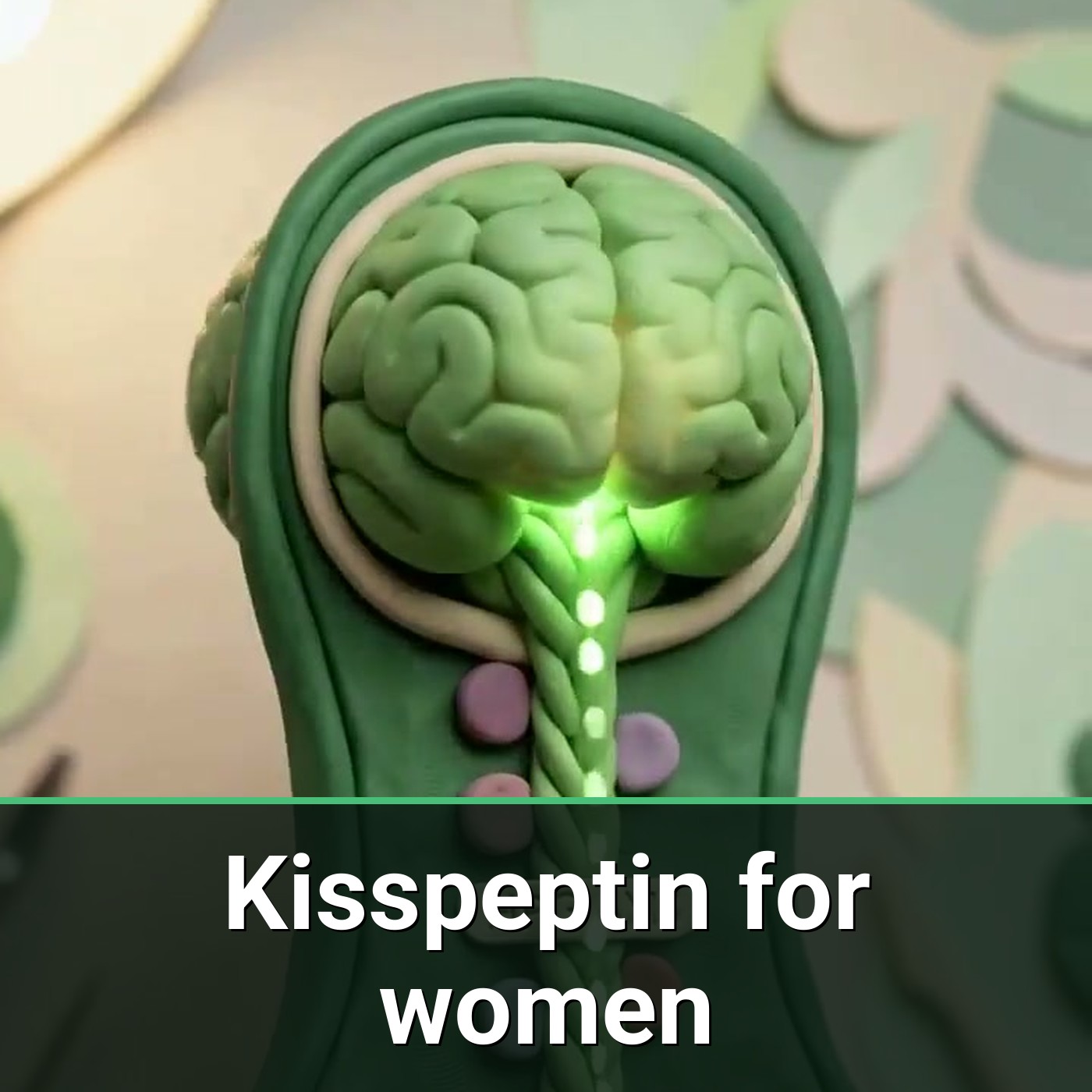
Now playing · Episode 55
Kisspeptin for Women: Menopause and the HPG Axis
Transcript
- Menopause, sooner or later, every woman lives this, most live it alone.
- No one prepares you, no one fixes it for you.
- Walk through perimenopause, the hot flash that hits you in a meeting,
- the 3am wake up that ruins the next day, the mood that swings before you can name it,
- the weight that won't move no matter what you do, skin that thins, hair that thins,
- libido that disappears, brain that feels foggy, joints that ache for no reason.
- This isn't a personality change.
- It's an entire system going offline.
- Your body has a hormonal signal between your brain and your ovaries called the HPG axis.
- For decades, it pulses on a clean rhythm, releasing estrogen and progesterone
- that quietly run dozens of body systems in the background.
- In perimenopause, that signal starts to break down.
- Estrogen and progesterone drop.
- And because every major system depended on those hormones, every system gets thrown off.
- Cellular energy drops.
- Collagen production stops.
- Sleep architecture breaks.
- Mood regulation falters.
- Bone density declines.
- The signal that ran your whole body is going quiet.
- There's a way to restore this system from three angles.
- Three peptides, each rebuilding a different piece.
- kisspeptin.
- The master signal.
- It's the same peptide your body uses naturally to tell your brain when to release the hormones
- that drive your cycle.
- When you supplement with it, you reactivate the conversation between your hypothalamus and
- your ovaries.
- Hot flashes ease because kisspeptin also regulates your brain's temperature center.
- Libido comes back because it activates your brain's sexual reward signaling.
- Mood steadies because the restored hormonal rhythm feeds serotonin.
- Bone density protects because estrogen comes back online.
- One peptide.
- The signal that turns the whole system back on.
- NAD+.
- The cellular fuel.
- Every cell in your body uses NAD+.
- To convert food into energy inside your mitochondria.
- When estrogen drops, mitochondrial efficiency drops with it.
- And you lose energy you never knew was hormonal.
- NAD+.
- Refills that fuel directly.
- Fatigue lifts.
- Brain fog clears because your brain is the most energy-hungry organ in your body.
- Exercise tolerance returns.
- Sleep deepens because cells finally repair properly overnight.
- And NAD+.
- Activates your sirtuin pathways.
- Your body's own built-in anti-aging machinery.
- GHK-Cu.
- The renewal peptide.
- After menopause, your collagen production drops by 30% in the first five years.
- That's why skin thins.
- Wrinkles deepen and hair starts to shed.
- GHK-Cu directly tells your fibroblasts to start producing collagen and elastin again.
- Skin firms and plumps.
- Hair follicles wake up.
- Wounds heal faster.
- And it acts as a powerful anti-inflammatory,
- calming the low-grade inflammation that menopause turns on.
- Restore the signal.
- Refill the cell.
- Renew the surface.
- Together, the version of you that menopause took quietly starts to come back.
- Hot flashes ease.
- Sleep deepens.
- Mood steadies.
- Skin firms.
- Hair thickens.
- Libido returns.
- Brain fog clears.
- Joints feel younger.
- You feel like yourself again.
- We call this combination of three peptides.
- The Bloom Protocol.
- Three pre-filled pens.